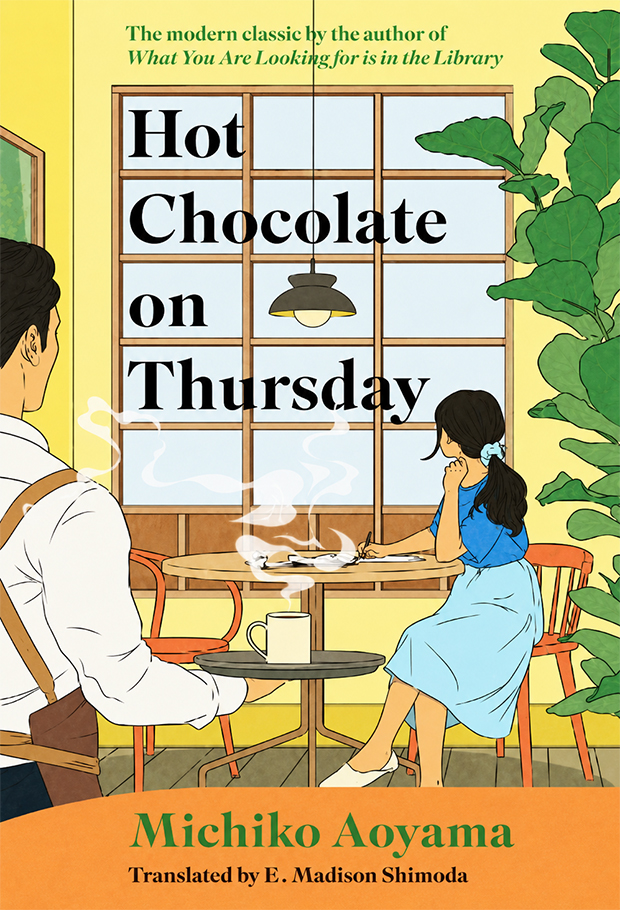
There is a woman who comes into Marble Café every Thursday, sits in the same spot, orders a hot chocolate, and writes letters in English nobody around her can read. The waiter — Wataru, young, capable, quietly smitten — has nicknamed her Ms Hot Chocolate in his head, because he doesn't know her real one.
That's the whole opening. A boy with a crush, a woman with a notebook, a café behind a row of cherry trees on a Tokyo riverbank. I went in expecting their story. A slow-burn, café-set romance, the kind of book that earns its ending in two hundred unhurried pages.
I did not get that book. I got something better, and it took me embarrassingly long to realise it.
Chapter two doesn't return to Wataru. It moves sideways — to someone who walked into the café for four paragraphs in chapter one, now standing centre-stage with an entire life I hadn't been told to expect. Chapter three does it again. And again, and again, twelve times over, each chapter handing the baton to someone who'd been standing quietly in the wings of the last one — a high-achieving mother undone by a rolled omelette she can't get right, a kindergarten teacher whose chipped nail polish accidentally remakes a child's sense of themselves, a married couple discovering Vegemite in Sydney decades into a marriage that has survived far stranger things. Aoyama gives each of these twelve chapters its own colour as a title — brown, yellow, pink, and so on so forth — and the colour isn't decoration. It's mood, season, the emotional register of that particular life, set like a key signature before the music starts.
Yes, this is not the first time I have read such a literary device. Aoyama isn't inventing the relay novel — the short story cycle that daisy-chains characters across chapters until the structure itself becomes the argument. It's the architecture Toshikazu Kawaguchi built his entire "Before the Coffee Gets Cold" series on, another café, another beverage standing in as ritual and rhythm. Aoyama herself has used a version of this scaffolding before, in "What You Are Looking For Is in the Library". So no, the bones aren't new. What's new — what makes "Hot Chocolate on Thursday" worth the embarrassment of being moved by something you can technically diagram — is how unshowily she does it. Nothing here strains for significance. The significance simply arrives, the way warmth does when you've finally stepped in from the cold. A working mother's panic in her own kitchen is allowed to just be panic, until somehow it isn't only that anymore.
The structure asks something of the reader that a straight narrative never does — patience, and a kind of faith that the digressions are not digressions at all. You hold each character a little loosely, because you suspect, correctly, that you'll meet them again from someone else's eyes a few chapters later, slightly altered by the angle. It's an act of architecture as much as storytelling — Aoyama is building a neighbourhood, not a plot line — and Wataru's manager, the half-mythical Maestro who owns the café and appears mostly in rumour, is the closest thing to connective tissue you're given. Everyone else finds their own way back.
And then, somewhere past the book's midpoint, the realisation lands: this is all coming back to her. Ms Hot Chocolate. The letters. The Thursday ritual that opened the book and was so easy to forget once the relay started moving. Naturally, I won't spoil how Aoyama closes that loop, except to say that the return doesn't feel like a twist being engineered into place. It feels inevitable in the way Thursday itself is inevitable — it was always going to come back around.
Sure, every chapter doesn't earns its warmth in equal measure. A handful of the stories — particularly once the book steps outside Tokyo and into Sydney — resolve a shade too neatly, the comfort arriving slightly ahead of what the material has actually built. Readers who like their short fiction to sit in irresolution a little longer might feel the seams here. I noticed it. Though I didn't mind it. This is not a book interested in being difficult.
What it is interested in — and what it does, chapter after chapter, with a consistency that becomes its own kind of beauty — is the unglamorous truth that we are constantly, invisibly, changing each other's lives in passing. A kind word. A shared drink. A letter someone else's eyes happen to fall on. You finish "Hot Chocolate on Thursday" wanting to do something about it — recommend it to a stranger, perhaps, the way the book itself keeps recommending its characters to each other.
I would. I actually have.