I didn't like the last version of Murder on the Orient Express one bit. In my own honest opinion, it was a disastrously made adaptation of by far the most popular Hercule Poirot story, one that had already been mastered to perfection on film in 1974. As the weirdly altered narrative kept unrolling, I couldn't help myself comparing it to Sidney Lumet's OG masterpiece. And yet, the real sore point wasn't even the story (which, don't get me wrong, was horrible) - it was the portrayal of Hercule Poirot by the otherwise extremely talented Kenneth Branagh. Branagh, also the director of the film, took his Hercule Poirot into a very different direction, one which wasn't true to Agatha's Christie's depiction at all. Gone was the quiet, sophisticated, tisane loving, slightly pompous Belgian - no, this was a more brutish, physically intimidating and outright insufferable Belgian who felt the constant need to demean everyone and everything around him to feel that surge of self-satiating omnipotence about himself. This Poirot wasn't one bit likable, instead this was more of a Sherlock Holmes on steroids!
All of this was greatly disappointing, more so since this had come from the stable of Kenneth Branagh - a genius by every yardstick. I understand the niggling need to alter the storyline somewhat, considering how popular and unsuspecting the original work has since become. There is nothing to be expected if one already knows what's going to happen next. But this felt perverse. Scintillating star power not withstanding, this movie was a humungous letdown.
That brought us to Death on the Nile, another remake of an earlier better made movie, with Peter Ustinov donning the role of the great Belgian detective, over from Albert Finney. Considering the rich pedigree of Christie's work, this constant need for someone as accomplished as Branagh to go back to classic masterpieces is beyond my comprehension. Had he chosen some of Ustinov's lesser known Poirot movies, I'd still have got the point. But to choose Death on the Nile as his second offering seemed absurd beyond belief.
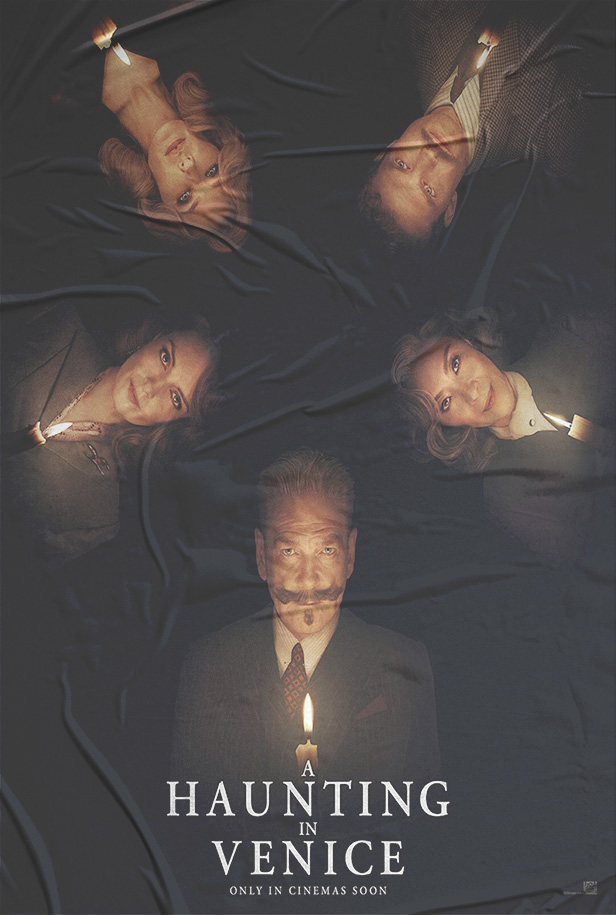
Thankfully, this madness finally came to a rest with his third feature in the series, A Haunting in Venice. Based on Agatha Christie's Halloween Party, we are introduced to a more subdued Hercule Poirot, one who had moved to Venice since the tragic events on the Nile in his previous adventure (considering we're following a straight line here). It seemed that the Belgian detective had entered a period of retirement, living a content life chasing his favorite deserts and doing absolutely nothing to stimulate his little grey cells.
All that changes when his friend, the American detective writer, Ariadne Oliver arrives in Venice and invites him to a seance at famed opera singer Rowena Drake's residence. The seance was to be conducted by the notorious Joyce Reynolds, a WWI nurse who had since changed profession towards the occult. The seance was being held to help Rowena commune with the spirit of her deceased daughter, Alicia, who had taken her life several years ago. Her distraught mother had finally wanted to bring closure to her daughter's untimely death. Miss Oliver's agenda to bring Poirot to this evening of intrigue was to expose Reynold's deceit and in turn, provide her with fresh matter for her next novel.
A Halloween party ensues that evening, and once everyone has left, the seance begins. Poirot is up to the task, explaining away haunting situations that develop through the course of the seance. However, things take a eerie turn when Alicia's spirit returns through the medium and reveals that she did not take her own life, but was killed by one of the guests present at the table.
Poirot shrugs off this development as more of Reynold's tricks to sell her craft, but someone then attempts to drown and murder Poirot when he is apple bobbing for a lark. Moments later, the killer finds their intended victim and Reynolds falls to her death, impaled by a statue. A horrible tempest growing outside, there is but nothing else to do in that house of death but for Hercule Poirot to investigate.
Needless to say, this script greatly deviates from the actual novel - but all things considered, this attempt at bringing a popular Agatha Christie murder mystery to the big screen actually works. There is nothing to compare the movie to, no earlier adaptation that merits undue attention and unlike the previous attempts, the story is airtight and holds beautifully on its own.
It helps that the principle character of Hercule Poirot is a lot more likable, a lot more canon, a lot more the Poirot that has since been popularized by David Suchet. Yes, it does not help that Poirot doesn't match the physical picture of what we've come to know from the books, but the character is halfway there - and after the fiasco of the Poirots from the earlier adaptations, this was a welcome relief.
The rest of the actors in this plot are equally on point. Everyone brings with them a sense of the mysterious, they are intricately intertwined with the plot and they stand out in their own limelight. This wasn't remotely the same phenomena from the earlier Branagh Poirot movies. And this makes the audience a lot more invested in the plot, in the narrative and in the final outcome.
The movie make a full circle as the events unfold, as more and more bodies drop, as the altered plot is made to come a whole. This movie was absolutely enjoyable - and that is one of the hallmarks of a good Agatha Christie murder mystery. Christie's stories are never meant to be some auteur brain-work, they're meant to be quick, interesting, hugely entertaining pieces of wonderment.
And finally, with A Haunting in Venice, we have hit the nail on the head. Now, we can finally look forward for Kenneth Branagh's next presentation on this subject with bated breath. It can't come soon enough.