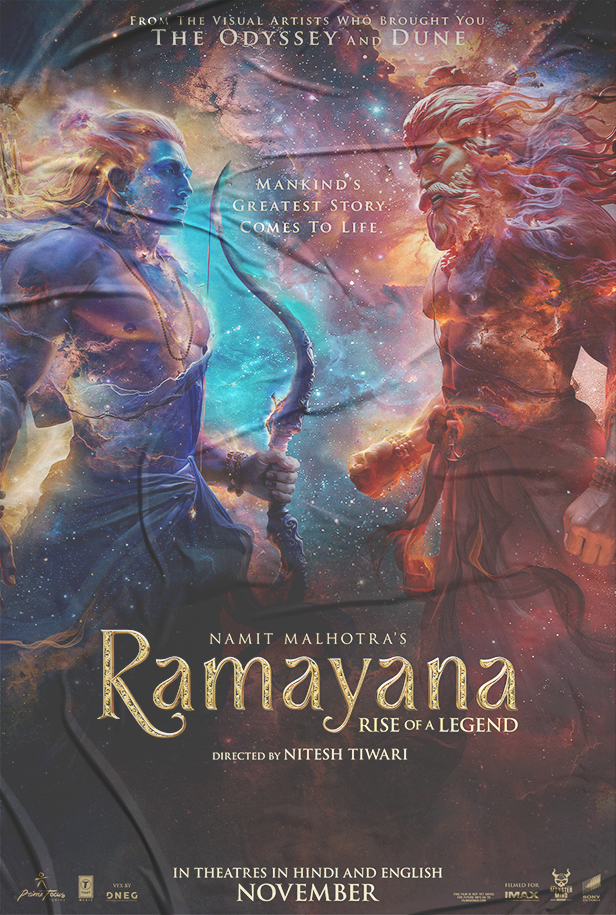
I don’t quite like using the term ‘magnum opus’ anymore these days. Not in the world of hyper-real CGI. Because if today’s films made over an, albeit spectacular, green screen, can be categorized as a magnum opus, then what do we call Ben-Hur?
So no, I won’t call Nitesh Tiwari’s Ramayana a magnum opus — but spectacular just doesn’t do it justice.
Now, the story and performances and the technical bits — those we’ll get to. However, let’s deal with the elephant in the room. While this might be a Nitesh Tiwari-directed Ramayana, the film is indeed referred to as Namit Malhotra’s Ramayana in most promotional materials that I have seen thus far. Namit Malhotra of DNEG, the world’s greatest CGI company, the actual hands behind every single Hollywood extravaganza that we have seen till date. Inception, Interstellar, the Dune films, Harry Potters, Blade Runner 2049 — we could be here a while. DNEG, whose CEO is Namit Malhotra, has finally brought that craft to Indian cinema. And honestly, where better to showcase your entire gamut of expertise than perhaps the Ramayana, quite literally one of the greatest epics of human civilization (the other one being the Mahabharata — the Homeric epics are too tiny compared to the scale of these, I am not counting them; also I am biased).
And so yes, while we have seen their work before, we know what they can do, we have seen them do the literal impossible time and again, it was absolutely magnificent to see them at work on an Indian production. And it truly was as spectacular as the hype was. Yes, some bits of it did feel a bit stale, a bit redundant, a bit too much — all at the same time — but it was fun. And that’s the principal point of CGI, in my opinion. I know it’s not real, I know it’s generated on computers, but I want to go in for the ride, willingly. Otherwise known as the willing suspension of disbelief. It scores every point imaginable on that score, and in some scenes — particularly Ravana’s fight with Jatayu — the detailing was absolutely immaculate.
Now that being covered, we return to the age-old story of the Ramayana. The makers very clearly establish at the very beginning that this film was based on the Valmiki Ramayana, not the million other versions of the epic that exist in the world; and definitely not Tulsidas’ Ramcharitmanas. That immediately tells us what to expect, and also how grounded the story truly was — the battle of good and evil, and every shade of grey in between.
What the film does is just not tell us the story of Ramayana as we know it, not the usual abridged version. No, it starts us off from the very premise of the epic, of how Dashanan becomes Ravana, how he stakes claim to the throne of Lanka; a near-immortal warrior king who was driven purely by the lust of revenge; but at the same time the most learned, the most capable, the most intelligent, the most devoted man to walk the three planes of existence. Ravana was not reduced to a caricature villain, not some man to hate for the sake of hating — to abhor Ravana, if I may put it so, one has to know who he was and how he got to where he did. Ravana, like in all great epics (yes, even the Homeric ones), suffered from a tragic flaw in his character. His desire for revenge may have been borne out of just cause, but even ten heads sometimes cannot counsel you to take the right path.
And whenever you have one insatiable demigod working his way towards conquering all the three worlds, that is when you basically need someone to rise and stop him. Lord Vishnu, the Preserver from the Hindu triumvirate, has to take birth in the land of men to eventually meet Ravana on the battlefield and stop him. But destiny is never a straight path. There are steps that take you to where you need to be, steps that define you and remind you of your true purpose to get there. And that is the story of Lord Rama.
The story is ably told, the script is sound. And the actors give it their everything to make it come alive. Ranbir Kapoor as Rama is every bit the divinity that he is out to portray. Sai Pallavi as Sita brings in a totally fresh and epic-accurate portrayal of Goddess Lakshmi’s avatar on earth, not being merely a companion through the story, but an active participant in the events that unfold. People often forget that her swayamvar had her suitors attempt to pick up Lord Shiva’s bow only because she had herself lifted the same with one hand as a child. She was never meant to be a hapless survivor in the epic, she was every bit the warrior princess that Lord Rama’s wife was meant to be. Lara Dutta as Kaikeyi, Ravi Dubey as Lakshmana, Kunal Kapoor as Indra, Rakul Preet Singh as Surpanakha — everyone does their job very well. And yes, Arun Govil as Raja Dasharatha felt nice to see, how a homage usually works.
But yes, I have reserved one entire paragraph for the true star of this entire first half. Yash, as Ravana. This first part definitely belongs to him. Not just Yash — I mean, to Ravana. It sets up the premise of the epic, and that doesn’t exist without Ravana. There would be no need for Rama if there was no Ravana. And honestly, there would be no Ramayana, the movie, if not for Yash. The man, loved and cherished by the entire country and beyond, doesn’t just bring raw ability to the role, what he does brilliantly is bring star power to the character. Indian films — maybe not recently, but over time — have always developed weak villains. I don’t mean in their character growth or definition, but in the final showdowns at the end. They go through an entire movie being all kinds of despicable evil, only for the hero to turn up and pack them off in no time. Yash doesn’t do that, since Ravana does not do that. Yash’s performance is beyond top-notch, every time he comes on the screen you sit up slightly. You expect the unexpected, you expect passion and stardom, you expect blood-curdling villainy, and you know it all stems from good reason. To be able to balance all that together — pure perfection.
The other hero of this epic film is the music. I’ve heard all sorts of Hans Zimmer. Have been hearing forever now. I know who he is, I know what he can do — and that is magic — and I know what he can bring to a movie of this scale. He was one of the reasons I was really waiting to go see this movie. And he left me speechless. I did spend a long time since trying to find the background score album for this movie, all I’m finding are bits and pieces — and that is just sad. Good music can raise many a movie beyond the craft and the performances. Exceptional music can make it immortal. Rama’s entry, Ravana’s theme, Rama invoking his divine weapons, Rama leaving for the forest — how many more instances can I point to that the music has just been mind-rattlingly exceptional? Goosebumps all day, every day!
And the point I made about the background score album not being available everywhere — that is the biggest flaw of the movie, in my opinion. The marketing. I mean, you’ve spent something to the tune of 4000 crores to make this movie, and robbed the marketing budget blind? I have seen more promotion for Cocktail 2 than for Ramayana, and that is saying something. You would think that even a thin sliver of the film’s budget in the hands of a competent marketing team would do wonders for an amazing film. But I guess you do end up dropping the ball somewhere. Thankfully, the actual movie itself didn’t take the hit for it.
Finally, as I close, I’d like to make one socio-political point — something that I strenuously avoid on this platform. We have become so fragmented as a society, as a people, that one of our greatest epics is also suffering today because of it. Making one of the greatest stories of the entire human civilization into fact — disagree and you die — by spewing bile and distrust in their names, we have forgotten the essence of our own heritage. One side was more concerned about how Sita can have curly hair, while the other tried to mock her period-appropriate jewelry and clothing (rather, the lack of it). Is that what the tale of Lord Rama is about? Talk about missing the forest for the trees! I remember how cinema halls were keeping one seat vacant in their screen for Hanuman during the Adipurush run; and this Ramayana is being treated by both sides with caution. This is definitely no Ram Rajya we are living in — and honestly, this isn’t the kingdom Ravana built either. That’s how low civilization has sunk.
Anyways, now we wait. For Part 2. And we pick up the story of Rama, Sita, Lakshmana, and Ravana — with Hanuman ready to tear his way into the screen. Finally.
Just one last point to end this epic of its own — Vivek Oberoi is an a**hole in this movie too.