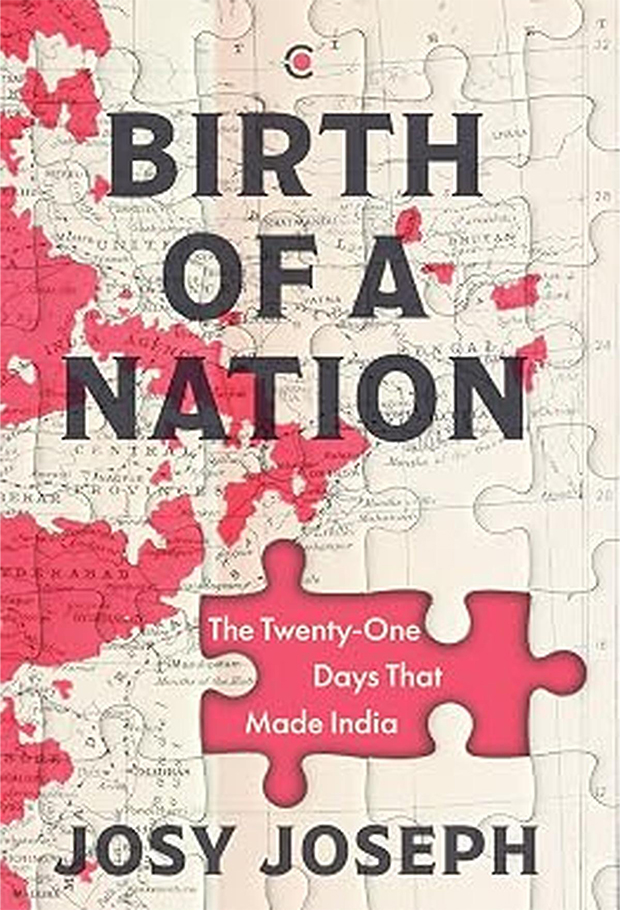
Birth of a Nation
The Twenty-One Days That Made India
Context, an imprint of Westland Books
“Know who we could have been, and who we are today.”
★★★★★
Reviewed by Subhojit Sanyal
The world is in a constant state of political flux, and in our very own context as Indians, this rings more true in 1947, when we were able to throw off the yoke of British imperialism and stake our own singular identity in a brave new world.
Singular identity.
We need to re-think that phrase slightly, particularly after reading Josy Joseph’s Birth of a Nation: The Twenty-One Days That Made India.
None of us Indians were clueless about this fact. Matter of fact, the state of Kashmir serves as a poignant reminder of how we stitched our identity as a country to this day and age. We have all heard tales of the Nizam of Hyderabad wanting a separate identity of his own; how the princely state of Bhopal was hell-bent on trying to be a Switzerland between newly-formed India and Pakistan. That the state of Travancore had its own ideas about a newly formed independent subcontinent.
To put it mildly — it was a mess!
Josy Joseph really breaks all of this down. Step by step, incident by incident, state by state. He paints us, the average lay history buff, a complete picture. No more guesswork, patchy internet reads — and god forbid, WhatsApp forwards that rewrite more history than even the current NCERT textbooks. Joseph takes us through the quite literal birth of a nation, of what we today know, love and cherish as India, the ultimate union of states.
His writing is brisk and effortless, not preachy at all, simple for the general reader to be transported to 1947 — in and around — and understand easily the situation that our political leaders had to fathom and deal with. There was the British on the one hand, Muhammad Ali Jinnah and his Muslim League causing all kinds of trouble and confusion — and then came the big batch of independent princely states who had kept themselves independent on paper all this time by quite simply paying off the Brits. But that transactional relationship was now coming to a close.
And the Nawabs and Rajas were not having it.
As per their understanding of this new unfolding situation, agreeing to be part of the new Indian Union would strip them of their kingdoms, their fiefs, their rule. Something that they had managed to avoid all through the British occupation of the subcontinent. A simple argument that makes us clearly understand how different the idea of India was at the time of independence. That what we had till that point, since 1857 or so, was something we can only call British India — which honestly, and literally, did not make up the whole of modern-day India, Pakistan, and Bangladesh.
The complications were real, acute, and rather stressful. There was no way to coerce the rulers of these states to join the newly formed country — or countries. The principle set into motion was sacrosanct — the princely states would have to make their own choice if they wanted to be a part of India or Pakistan. Now, in practice, this decision seemed somewhat easier for those states in the immediate neighbourhood of the newly drawn up Radcliffe Line. But what about the states of Travancore or say Hyderabad? It seemed quite obvious that they would have to accede to India.
But not if Mr Jinnah had his say in the matter. From one ridiculous proposal — like having a 1,000-mile channel running from West to East Pakistan through the heart of India that would belong to Pakistan, to trying to foment ideas in the Nizam of Hyderabad’s head of Pakistani support in the event of any trouble with India — he was clearly showing signs of doing more than just wanting a new country for his people.
And that is when Joseph’s book allows you to take a more exhaustive peek into how Jawaharlal Nehru and Vallabhbhai Patel used their collective genius in bringing all the chickens home. What one understands on reading the book is that Nehru and Patel truly played the classic game of good cop-bad cop, with Nehru threatening dire consequences and Patel trying to make these errant rulers see reason.
If you aren’t totally ruled by ideology and take a more unbiased approach towards the historical turn of events, Joseph’s book shows you how India came to be. Yes, there were errors and fumbles; yes, it required both a hard and a soft touch; and yes, it was all worth it in the end.
At the cost of sounding repetitive, yes, India is a union of states. But only when you read Josy Joseph’s Birth of a Nation do you start to realise the true import of those words. You realise how difficult the road has been till here and how history is more than just political speeches and jargon.
Get a better picture of India. Read Birth of a Nation: The Twenty-One Days That Made India. Know who we could have been, and who we are today.