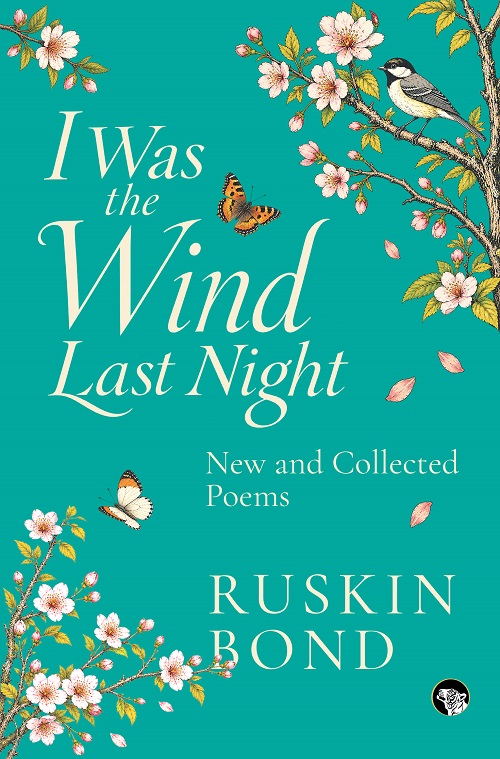
I Was the Wind Last Night
New and Collected Poems
Speaking Tiger
“He doesn’t ask you to escape the world. He simply reminds you to look at it again.”
★★★★★
Reviewed by Ahana Chaudhuri
Every time I return to his writing, I find something new to fall in love with. The wonder and awe that comes with paying attention to the world around you. Looking at the ordinary ever so closely till it reveals how much magic it holds. Where a red ant can inspire a poem. Spiders on a wall get pet names and find themselves in a rhyme. Where walnut trees, old loves, and rain in the hills are never the background. They are the main characters.
‘I Was the Wind Last Night’ is like a charcuterie board. There are discoveries. Like so many of Bond’s books, this is one you can return to again and again.
His poetry is lucid like all his writing. Easy to read, easy to understand, easier to feel.
They don’t beg those difficult questions, “What did the poet really mean?”
When he writes “This is old Dehra
Of mangoes and lemons”, you see a long lost garden and a sunny veranda in Dehra.
In ‘Trees of God’, you feel his anguish for the Deodars, older than the cedars of Lebanon, cut down thoughtlessly. You feel the words as he laments the short-sightedness of man.
‘Cricket-Field Placings’ and a ‘Plea for Bowlers’ take you to the silly point of Bond’s mind making you crack a smile.
There are poems in the book from 1963. His first year in the hills.
It has ‘Night Rhyme’. The first poem Ruskin Bond ever wrote.
There’s a poem about a bat that used to visit him in Maplewood, Mussoorie. One about bedbugs. Another one about a snake and a screaming frog.
There’s one about his attempts to drive a Land Rover in Delhi.
It has a poem called ‘Lone Fox Dancing’, also the name of his autobiography.
There are poems you would like to take a picture of to send to a friend. And then there are those that strike a grittier note. He doesn’t mince his words in ‘We are the Babus’, ‘Slum Children At Play’, ‘Home from the Burning Ghat’, ‘Dragonflies’ and you get a sense of rot and decay, a world removed from the postcard-perfect hills we so readily associate with him.
It’s a reminder that the man who finds magic in a garden is also an astute observer of everything that’s wrong with the world beyond it.
Then there are haikus you will want to re-read.
“There’s a begonia in her cheeks,
Pink as the flush of early dawn
in Sikkim’s peaks.”
Or
“When I was a boy I dreamt of wealth and fame;
And now I’m old I dream of being a boy again.”
I’ve folded a few pages, stuck a few sticky notes and made the book my own. If you’re a messy reader like me, you’ll find yourself doing that as well.
The great thing about a book like this one is you can read it from anywhere. Flip a page open with a cup of coffee. Read one between chores and meetings. Or read it all in one go. It’s snackable and devourable. If your day is a room, this book is the window with a view that someone has left open. A little breeze comes in. You hear the rain, see the trees, perhaps spot a red ant going about its business. And no matter what else the room holds, there’s suddenly somewhere else to look. That’s the lovely thing about Ruskin Bond. He doesn’t ask you to escape the world. He simply reminds you to look at it again.