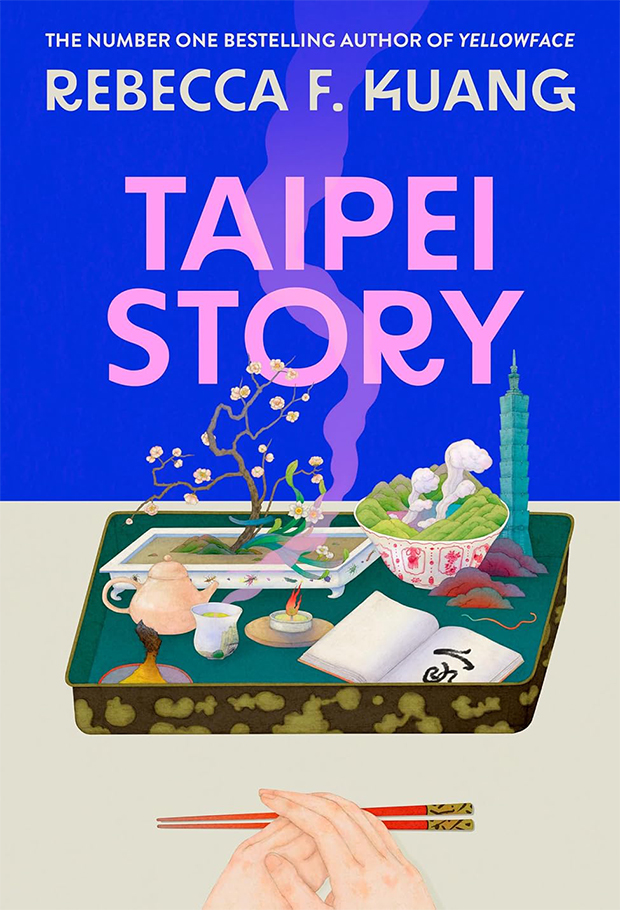
Taipei Story
The Borough Press
“Lily’s Taipei Story isn’t just about learning a new language. It is learning about life itself.”
★★★★★
Reviewed by Subhojit Sanyal
A standard romantic fiction, or a thriller, or even a detective mystery is one thing. These are easy. They have stories to say, they say it simply, add some fluff around it depending on genre, and it’s done. If the story itself is good enough to hold your attention, to intrigue your wits, and if it is well written, then you’re through. With all the ingredients added and properly stirred in, the reader is more often than not happy.
Literary fiction is another story altogether.
There are layers to go deep into. Ostensibly it’s the writing; then the general idea of what the narrative is trying to establish, the text within the lines, etc. — basically everything that we learn in our English graduation classes in college. Sure, if push comes to shove you can apply all of these to basically any piece of text, but you know what I mean. Maybe I’m being a bit classist (a bit?), but stereotypes exist because they’re more true than not.
And then there’s Taipei Story by Rebecca F. Kuang.
Yes, this is typically in the contemporary literary fiction genre that I made the huge song and dance about. The themes are right there for all to see. There is serious depth in the story and the structure, and there’s quite a lot going on from start to finish.
But beyond all that — or rather, in spite of it — what we’re really left with is an absolutely wonderful story of a young American girl of Chinese origin finding her way to her Chinese roots by enrolling in a language learning course in Taipei, Taiwan. It is a very simple tale told simply, a story that you are invested in right from the very first pages. There is no long preamble, there is no build-up — you’re just in it right from the very start, just the same as Lily Chen, our extremely lovable protagonist.
Sure, this is a coming-of-age novel. Lily comes to Taipei to learn a language — a language she knows, a language she already speaks, but is nowhere fluent in. She really believes that learning Chinese in its entirety will allow her to understand who she is, help her connect with her parents and family better, and also let the world know who Lily Chen really is.
However, a lot happens by the time she leaves for home again. Already irritated by her sisters back at home, she understands how much more difficult it is to live with a roommate in a different city/country/continent; she learns how quickly rumours spread to leave you with a reputation to salvage; she tries to fathom the outcome of her intentions when she learns about her grandfather’s passing; and through all of it she slowly becomes an adult with each passing day, learning, growing, becoming a newer version of herself through the experiences of life.
Lily’s Taipei Story isn’t just about learning a new language. It is learning about life itself.
Yes, there are themes. A lot of them. The whole coming-of-age trope, a very subtle (and sometimes not so subtle) tread on finding one’s identity, of grief and a family history that is as vague as it is clear — and all of it comes full circle for Lily from the time she lands in Taipei to the time she heads back home. Language, which Lily hoped would help her build bridges, ends up acting as much a barrier as it serves her purpose. Lily claws her way through a language she knows and doesn’t know, and even after all that effort she realizes that she will never be able to ask her late grandfather the questions she wanted to, or her grandmother who has slowly lost control of her mental faculties with age. Does learning the language finally make Lily more Chinese, or is she still very much the American girl she was born as — slightly different from her parents, the first-generation immigrants, and very different from her grandparents whose alienation from her only seems to grow several notches with the passage of time.
And even in that hunt for her Chinese identity, Lily — like so many other second- and third-generation immigrants have to deal with — has to figure out whether she is more Mainland Chinese or Taiwanese Chinese. Kuang’s tryst with identity serves as several layers of an onion. You keep peeling layer after layer, and still you’re only halfway there to the core.
Rebecca F. Kuang’s Taipei Story, stripped of all the nuances it conveys, is very beautifully written. It doesn’t try to force a realisation on you — far from it, it just tries to tell you the story of a young girl in a half-home country, only she’s far away from her real home — figuratively and metaphorically. And about everything that happens to her on the way. Lily Chen is perhaps all of us, and yet she is none of us. But we can all definitely identify with her ambitions, her objectives, her struggles, and her failures.
Lily Chen’s adventure is our adventure. Her discovery is our discovery. And her coming full circle is what we have all done in our own lives, or at least hope to.
Taipei Story by Rebecca F. Kuang is the story we write of our everyday lives. And that is what makes it so beautiful.