Literary Fiction
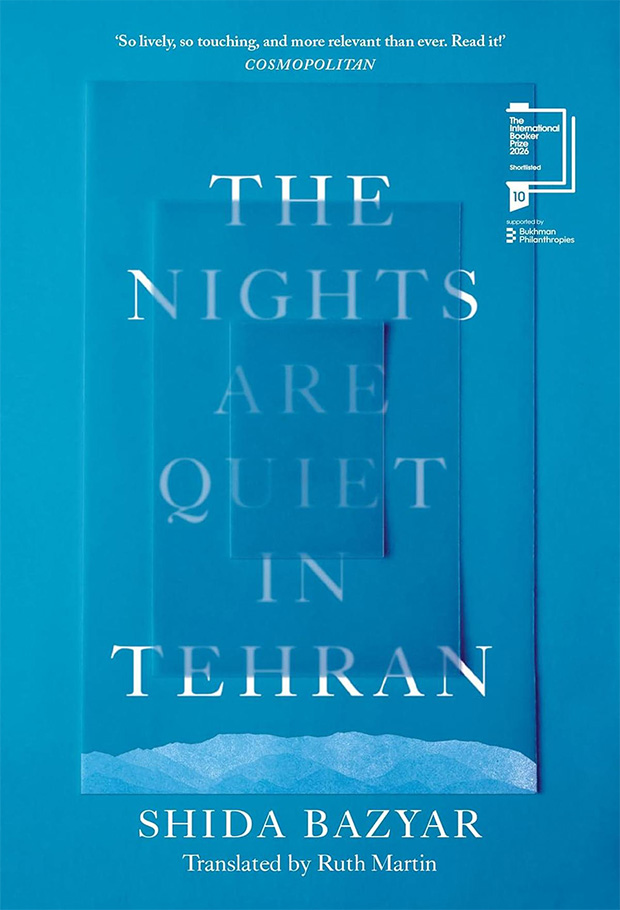
The Nights are Quiet in Tehran
HarperCollins · Trans. Ruth Martin
"Hope doesn't die, because courage cannot be measured in any metric whatsoever."
★★★★★
Reviewed by Subhojit Sanyal
Yes. And no.
The Nights are Quiet in Tehran offers up all these questions and doesn't really bother answering them in explicit detail. Because truth be told, the answers are there within all of us. These questions are universal. These questions bubble and burst within all of us. And more often than not, the answers never arrive. Not for the characters in the book, not for each and every one of us.
But not once do we stop to hope. Not once do we dream of a better tomorrow. Lifetimes pass, generations come and go, but that light at the end of the tunnel does not dim. Maybe that is the only universal truth that there is. Maybe that is all there is to life.
Shida Bazyar takes us through the lives of one family, two generations of them. We fight the revolution first through the eyes of Behzad, the idealist, the freedom fighter, the revolutionary, who fights against the Shah's oppressive rule and yet doesn't taste victory with the arrival of the Ayatollah's Islamists. It gets worse, the establishment pushes back deeper, more viscous, his comrades start disappearing, news of ruthless torture flood in, the dreams of an egalitarian Iran disappear. And so does Behzad.
When we start to see a brand new world through the eyes of Nahid, Behzad's co-revolutionary and now wife, in 1989 Germany. Unable to take the strain of the despotic establishment, the stress on the families of the revolutionaries, the couple escape to Germany as refugees with their little children. A new life, a different life — but one can hardly ever escape their roots, their past. Nahid watches her husband try to adapt to their new life, he does everything that is expected of him — but he's only a shell of the man he used to be. Nahid sees everything, Nahid tries her best to be brave, Nahid does everything that is expected of her — but you soon realise that while she might physically be in Germany, her soul was still left behind in Iran. Not only because of the family she left behind, not only because of the home she left behind — but because the man she married was also left behind in her homeland. The person who came with her was merely the father of her children.
By 1999, we start seeing the world through the eyes of Laleh. She's more German than her parents could ever be; but she's also Iranian. She is the perfect duality that a child of refugee parents becomes. She knows who she is, no doubt, but she also wonders if there is more to her than she herself realizes it. And this feeling, this mystery compounds itself further when she visits Tehran with her mother, meets the family she heard of and only seldom saw. Laleh becomes the melting pot of two cultures, of two civilizations, of two people trying to live as one. Her travels within Tehran remind her she's German, just as much as her life in Germany reminds her she is Iranian. But even as Laleh bridges this gap like a champion, maybe it is the world around her that refuses to take her for who she really is, but instead and who they think she could be.
And by 2009, we are with Morad — known better as Mo — the second child of Behzad and Nahid. Mo is the Iranian kid with Western values, the gradual transition in a family that went from revolutionary Iranians to full-fledged European citizens. Mo is connected to Iran, particularly to the Green Movement of that period — but through social media. He has hardly ever been "home", he sees the entire movement through the western lens of equality and practicality. A university student, Mo and his friends live lives that border on the cusp of revolution and loss. But they function with the same idealism that students across the world do — for a better tomorrow, against oppression and tyranny, for a world where everyone is truly equal. And as a German citizen of Iranian descent, who has seen the flame dim in his father, a flame that he hardly witnessed but heard more of, Mo walks the tightest of tightropes. He is not his parents, he is not his sister — but he is someone still interested in the struggle, still in the fight. Even if only barely.
And ideally, that is where the tale ends. Or should have ended. But we are taken into a brief glimpse of Tara, the youngest daughter of Behzad and Nahid. Unlike Laleh and Mo, Tara was the only child of the family to be born in Germany. Her fleeting connection to her roots came from the fragile bond that her family shared with their home country, and the fact that she visited Iran with her mother and her sister in 1999 — only she was a little child who spoke her mind more often than not. Much to the chagrin of Laleh. But Tara is more German than Iranian. She has embraced the more Western outlook to life and society, she is the total rebel, as defined by any Islamic/Asian household. But most importantly, she is free. And therefore it is poetic justice that the epilogue to this novel comes through the eyes of Tara — and technically Laleh's child, her niece, on a digital detox in Sweden, in an untamed time period — when they stumble on the news, almost accidentally, of the establishment having fallen back home. Two individuals at this point, Germans, with no ties to Iran, the country of their descent, fall to their knees as the news floods in suddenly on their phones, messages storm into their phones with the happy news. Tears of joy rush to the fore.
Because wherever you are, whoever you might have become, you cannot rid yourself of the fight that your people have been fighting forever. You are part of that fight, however you choose to fight it. Because you are who you always have been. Because hope doesn't die, because courage cannot be measured in any metric whatsoever.
The Nights are Quiet in Tehran. By Shida Bazyar.