Biography · Music
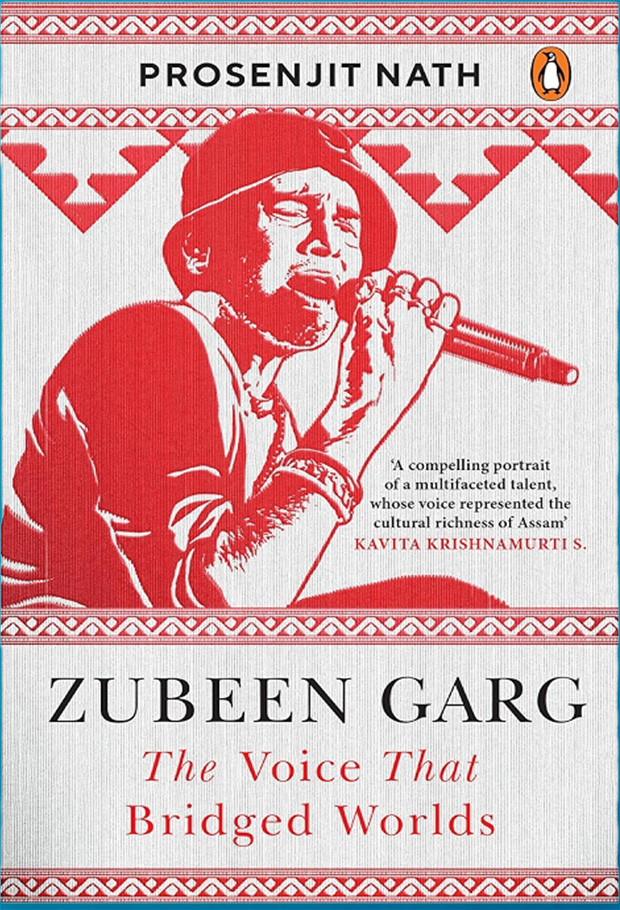
Zubeen Garg: The Voice That Bridged Worlds
Penguin Random House India
“When he sang, there wasn’t a single fake bone in his body.”
★★★★☆
Reviewed by Ahana Chaudhuri
Now, if you’re like me, you probably knew Zubeen as “that guy who sang Ya Ali.” But Nath’s book mentions Zubeen sang over 38,000 songs in more than 40 languages. The beautiful thing about a book like this is that it makes you engage with the music. I discovered tracks like Roi Roi Binale, albums like Ujan Piriti and spent a few days stepping into an entirely new universe.
Zubeen was a Renaissance man – a lyricist, composer, singer, actor, director. Trained in Hindustani classical, tabla, and Assamese folk musical traditions. He modernized the region’s music scene, setting up better studios, venues, and networks for young artists. Zubeen once compared himself to the Kanchenjunga mountain, a permanent feature of the landscape that shapes everything around it. And he really was.
People in Assam didn’t just listen to him, they lived with him. His songs were playing in every crowded bus, every roadside tea stall, and every late-night session where people stayed up talking too late. From festivals to life milestones, falling in love to heartbreaks, Zubeen’s voice was a constant. And for those of us outside the region, his voice was in many ways the first real door into the North East. You picked up one of his songs, and suddenly you were down a rabbit hole, realizing just how much incredible music was coming out of a part of India the rest of the country barely listens to. He was flawed, loud, and opinionated, but when he sang, there wasn’t a single fake bone in his body.
What truly stood out for me through the book was his humanity. He called out government failures, spoke up against the discrimination North Easterners face in mainland India, and famously declared, “I have no caste, I have no religion.” Interestingly, after he passed, religious institutions across different faiths held memorials for him.
It is rare for artists to be truth-tellers in the times we live in, and when one man goes ahead and does that time and again, it gives people hope. If we must idolise anyone, now more than ever, perhaps the only people worth idolising are those with a spine like Zubeen’s.
The book talks about how his Kalaguru Artiste Foundation led major flood relief efforts, supported local artists, provided grants for projects, created opportunities for emerging talent, and during the peak of the pandemic, how he converted his own home into a COVID Care Centre.
Nath captures Zubeen in his larger-than-life avatar, though sometimes he shows the chinks in his armour. I would have liked to read more about how a life so extraordinary was made possible by the steady influence of his wife, Garima Saikia. Musically gifted herself.
His dual identity as a Bollywood aspirant in Mumbai and a big star in Assam, the push and pull of two different realities is interesting to read. His struggle to find a foothold in Bollywood and his eventual return to Assam is an unlikely hero’s journey. Nath writes beautifully: “The home he never quite found for himself, he created in the hearts of his listeners. And perhaps that is the artist’s eternal paradox: to give to others what one cannot quite give to oneself.”
Ultimately, the book makes you engage with his music as much as it makes you think about his person. An artist is not made great by talent alone, an artist is made by the life he lives, and this book is proof of the fact that Zubeen lived a big life. One where his songs went on to become more immortal than monuments.