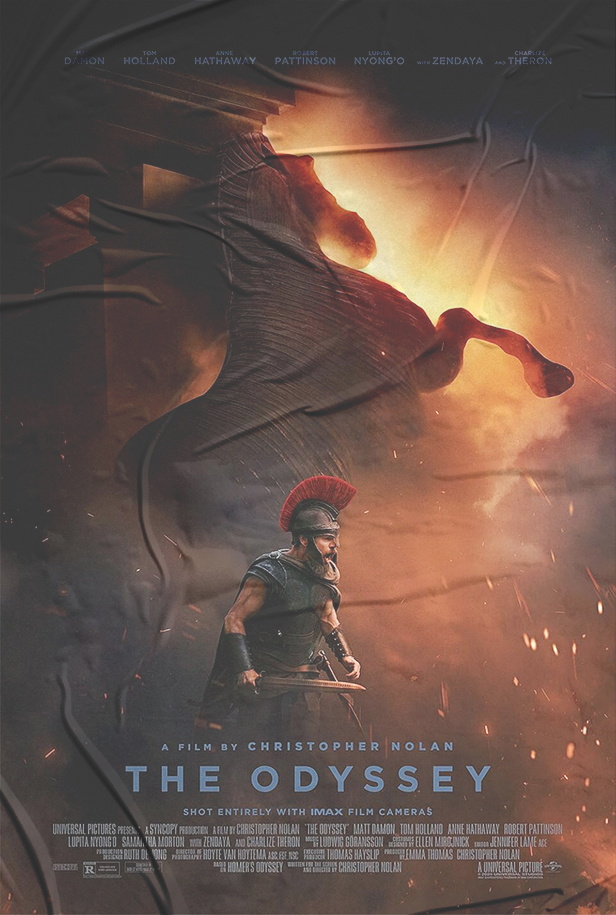
Christopher Nolan is one of the greatest living film directors of our time. Far, far into the future, like it is now, his name will be taken with the all-time greats of the film industry — from absolute legends like Orson Welles and William Wyler, to complete enigmas like Akira Kurosawa and Alfred Hitchcock, to name just a few examples. The one person I personally believe he has the most in common with is Stanley Kubrick. Both of them follow the principle of absolute storytelling, bringing their narrative best into a film, using every aspect of filmmaking at their disposal — and bringing all of it together, they create something magical before us viewers.
And then in 2026, Christopher Nolan goes on to give us The Odyssey.
Cinema is one thing, but what Nolan has gone on to define in this movie will want for a better word. Because cinema does not just do it justice; because if this is cinema, what have we been watching for all this time? No, cinema won't do it, because this is grander, this is captivating, this is the very pinnacle of storytelling that has perhaps the same impact on us that a bard might have had in his generation with only the tools available to him back then. His voice. That voice, that rendering of an epic tale, that story of Kings, Gods, and blood lust that has stood through the test of time and civilizations, that is something that perhaps Nolan has been able to achieve in his own timeline. And while there may be many from the flock of the Elon Musks who tried to write this movie's obituary even before it was released — be it the casting of Helen being taken away from the traditional blonde white, based more on Western White Supremacy than actual Homeric detailing, to the casting of Elliot Page, who they thought was going to play Achilles (a character missing from the movie as it turned out) — Nolan's The Odyssey will remain at the pinnacle of what he has managed to achieve. Something beyond mere cinema.
The story is generously told in sections which merge beautifully to tell us the tale of the Greek King Odysseus — from his brilliant exploits at Troy, and then through his epic journey back home. We see his home ravaged by obnoxious suitors who have come for the hand of Penelope, Odysseus' wife, while we see Odysseus and his men fighting fate and fury to return home. We go through the lands of magic, of giants and witches, of things mythical and mystical, we see Gods and demons and everything in between, we feel the weight on Odysseus' shoulders of fighting through the elements, and the horrors of the war he has just left behind — and we can hardly manage to keep our mouths closed to shrug off the disbelief of the poetry in images that we have witnessed in front of us.
And it wasn't just the performances, the screenplay, the epic camera work — it was literally the sound design of the film that needs special mention. Yes, Ludwig Göransson's background score gives you the chills that an epic masterpiece like this movie should — but it is the sound design which gives the movie its structure. The twang of the bow falling in step with the suspense of the scene, the Cyclops' roar, the emotion in the silences — everything is heightened because Nolan knows how to marshal everything at his disposal to make something epic go beyond its dictionary definition.
While performances in a movie of this scale, with a cast this goated, are absolutely a given — the representation of Agamemnon, played by Benny Safdie, was on an absolutely different level. Agamemnon is played up as a literal larger-than-life character, his villainous resolve evident in his get-up, the way he stands, how he moves. We don't get to see him, his face, ever. But he commands the scene when he's in it — and it is almost never in a good way. He's mean-spirited, he never speaks — he doesn't rule, he commands; but only till he's alive. That is the mastery we find all over this beautiful film — the treatment, the technique. Special credit is also due to Matt Damon for his portrayal of Odysseus, particularly since it pressed forward on the tragic flaw that ancient Greek literature is so famous for. He is a brilliant man, no doubt; he is brave, resourceful, and noble; but then he can also be a bit of an ass, most aptly when they sail across the islands of the sirens and he makes sure that his crew can't hear their voices and their songs, but makes sure he's the first person to hear the sirens sing and live to tell the tale. Even in the original, Odysseus is quite the repeat liar, making it very hard to take his tales seriously — and Damon brings that to the fore quite naturally. Himesh Patel as Odysseus' trusted right-hand man, Eurylochus, also deserves special mention for balancing the right amount of loyalty, mutiny, and getting more and more irritating as the going gets tougher for them to get back to Ithaca.
Samantha Morton as Circe was a powerful performance, playing multiple shades of the same personality with absolute elan. She turned from lady in distress, to evil witch, to tragic character effortlessly and serves as another constant reminder of her limitless range as an actor. Anne Hathaway as Penelope managed to grasp the two sides of her frustrations — the loss of her husband, Odysseus, and the suitors in her castle, plotting the death of her son and reducing the honor of Ithaca to rubble in the wake of their revelry. You feel for her, and on multiple levels. Yes, the performances were magnificent, across the board.
Homer — or, if I may, Homer(s) — told us the tale of the King of Ithaca, finding his way back home. Christopher Nolan showed us that it was way more than just that. It wasn't just about the tale, it was about how the tale is told.
Christopher Nolan is our Homer. And we should be really glad to live in the same time as him.
Good storytelling est magnifique.